



Fuel Improver | Specialized Plant-Based Enzyme Formula
Simply add 1/10,000 to your fuel. This helps reduce the cost of replacing DPD/DPF and injectors, as well as lower fuel costs. No stirring required—just add it and you’re ready to go.
User Success Stories
We tackle the “hidden costs” that erode profits in the transportation industry by adding a special plant-based enzyme that costs 1/10,000 the price of fuel oil.
80010,000 Yen
Annual Cost Savings: Reduction in DPD replacements from 10 to 2 per year (Large Trucking Company A)
72010,000 Yen
Annual Cost Savings: Injector Replacement—10 units per year → None in the following fiscal year (Long-Haul Trucking Company B)
27.3 → 13.3%
Black Smoke Pollution Level (Diesel Vehicles—Measured by Kitakyushu Automobile College)
1–5%
Improved Fuel Economy (Average Across Multiple Models)
*The performance data shown here are reference values based on field tests and user reports. Actual performance may vary depending on the vehicle, fuel, and operating conditions. *The analysis results and comparison data are based on results from a sister product.
Are you losing profits because of these issues?
- Manual regeneration of the DPD/DPF is occurring at least three times a week.
- Replacing the DPD and repairing the muffler costs between 1 and 2 million yen per vehicle.
- We have to replace injectors (720,000 to 1,000,000 yen per unit) on several vehicles each year.
- Due to soaring fuel costs, the more we drive, the lower our profit margin becomes.
- We continue to miss out on sales opportunities due to vehicle downtime caused by repairs and maintenance.
- Facing complaints about black smoke and exhaust fumes, as well as risks related to environmental regulations
What is ADD UP?
It uses the power of enzymes to reform fuel oil and promote efficient combustion. This not only improves fuel economy but also offers benefits such as reduced black smoke, decreased fuel sludge buildup, and extended service life of components (such as DPFs, mufflers, and fuel injectors).
While conventional additives primarily consist of heavy metals and surfactants, “ADD UP” uses active, plant-derived enzymes. By adding just one ten-thousandth of the fuel’s volume, it cleans the interior of engines, boilers, and other equipment, aiming to keep them operating with minimal strain at all times.
ADD UP is a new type of fuel improver that promotes environmental protection in the energy sector.
| Active Ingredients | Special Enzyme System (Multi-Purpose) |
|---|---|
| Amount to Add | 1/10,000 of the fuel oil (10 ml for a 100-liter tank) |
| How to Add | No stirring required. Simply pour it into the fuel tank. |
| Compatible Fuels | Gasoline, Diesel Fuel, Heavy Fuel Oil A, Heavy Fuel Oil C |
| Main applications | From passenger cars to heavy-duty trucks, ships, and boilers |
| Sales Results | 47 years (with PL insurance) |
Why aren't conventional additives sufficient?
| Conventional additives (surfactants and heavy metal-based additives) | ADD UP (Special Enzyme System) | |
|---|---|---|
| Effect | Primarily temporary dispersion (prone to reaggregation) | Sustainable Micronization and Dispersion of Asphaltenes |
| Traces | Risks Associated with Combustion Residues from Heavy Metals and Solvents | Formulated using applied microbial technology. Leaves minimal burn marks. |
| Effort | Stirring is required (labor and equipment costs) | No stirring required. Just add it. |
| Combustion | There are limits to how much combustion can be enhanced | Aims for complete combustion and helps reduce soot loading in the DPD |
| Amount to Add | 1/2,000 to 3,000 | 1/10,000 |
*The analysis results and comparative data are based on results from a sister product.
Empirical Data
| (data) item | Results | remarks |
|---|---|---|
| DPD Exchange (Large Trucking Company A) | 10 units per year (1 million yen per unit; 10 million yen annually) → 2 units the following year (reduction of 80%) | Annual cost savings of 8 million yen |
| Injector Replacement (Long-Haul Trucking Company B) | 10 units per year (720,000 yen per unit; 7.2 million yen annually) → No replacements required in the following fiscal year | Annual savings of 7.2 million yen |
| Black Smoke Emissions (Diesel Vehicles—Official Testing) | 27.3% → 13.3% | Kitakyushu Automobile College: Measurement Department |
| Fuel Economy (Hino Profia 12t) | 3.20 km/L → 3.58 km/L (+121 TP3T) | The average across multiple vehicle models ranges from 1 to 51 TP3T. |
*The performance data shown here are reference values based on field tests and user reports. Actual performance may vary depending on the vehicle, fuel, and operating conditions. *The analysis results and comparison data are based on results from a sister product.
Customer Testimonials (Shipping Companies)
Previously, we replaced 10 DPD units per year (1 million yen per unit), resulting in an annual expense of 10 million yen. After implementing ADD UP, the number of replacements dropped to just 2 units the following year, achieving an annual cost savings of 8 million yen.
I added ADD UP to a vehicle whose DPD clogging warning light had come on. After using it for a few days, the clog cleared up and the warning light went out. The engine is running better, too.
We were spending 720,000 yen to replace a single injector, which amounted to 7.2 million yen annually for 10 injectors. After introducing ADD UP, we had no injector replacements in the following fiscal year.
We noticed an improvement in fuel efficiency after several months of continuous use. The effect was particularly noticeable in vehicles used for long-distance travel, where we observed an average improvement in fuel efficiency ranging from 1 to 51 TP3T.
Why is a 1/10,000 concentration effective?
Special plant enzymes break down “asphaltenes”—a factor contributing to incomplete combustion in fuel—into ultrafine particles, with the goal of improving fuel atomization efficiency.
It helps prevent the buildup of sludge and mold, reduces deposits in the injectors, and helps prevent clogging.
We aim to reduce the generation of large soot particles, normalize the DPD’s automatic regeneration cycle, and minimize the need for manual regeneration.
It reduces the load on the injectors, turbocharger, and the entire DPD system, helping to lower repair costs over the long term.
Three sizes to suit your needs and scale
From personal vehicles to large fleets, just fill up whenever you refuel. Please contact us for pricing and availability.
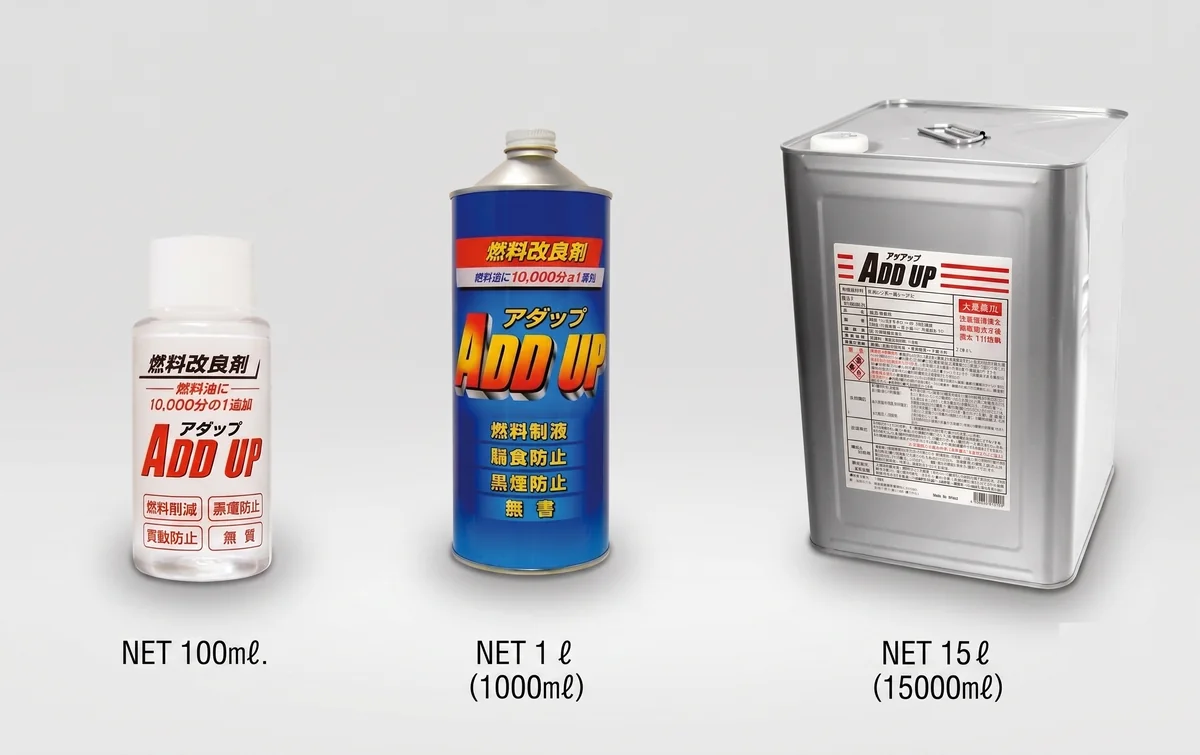
100 ml Mini Bottle
NET 100 ml / 12 bottles per medium box × 4 boxes (48 bottles total). Minimum order: 1 case (48 bottles)
1-Liter Standard Can
NET 1,000 ml / 6 bottles per case. Minimum order: 1 case (6 bottles)
15L Commercial-Size Can
NET 15L. We also accept orders for 200L drums. Minimum order: 1 drum or more.
Watch the video for more details
Estimating Annual Cost Savings for Our Company's Fleet
Please enter the following three items: number of vehicles in your fleet, number of DPD/DPF replacements, and monthly fuel costs.
*These are approximate figures. Actual results may vary depending on the vehicle and usage conditions. Please contact us for a detailed estimate or to discuss installation.
Frequently Asked Questions
Does it take a lot of effort to set up?
No stirring is required. Simply add it at a ratio of 1 in 10,000 to the fuel oil. For a 100-liter tank, that’s 10 ml. Just add it when you refuel; no special equipment or technical skills are needed.
Will this have any negative effects on the engine?
ADD UP uses special plant-derived enzymes (microbial application technology) and features a formulation that differs from conventional products, which primarily consist of heavy metals and surfactants. The manufacturer has a 47-year track record of sales and is covered by product liability insurance.
How long does it take to see results?
For vehicles with the DPD warning light on, there have been reports of noticeable changes occurring within a few days to a few weeks. Improvements in fuel economy are typically noticeable after a few refueling cycles (1 to 2 months), and continuous use for 1 to 2 months is recommended to clear clogs in the fuel injectors.
How is this different from conventional additives?
Conventional products (surfactant- and heavy metal-based) primarily provide temporary dispersion and carry the risk of leaving combustion residue. ADD UP uses a special enzyme system designed to achieve sustained micronization of asphaltenes. The required dosage is also 1/10,000, which is significantly lower than that of conventional products (1/2,000 to 3,000).
Can it be used with any type of fuel or vehicle?
Compatible with gasoline, diesel fuel, Heavy Oil A, and Heavy Oil C. We have a proven track record with a wide range of applications, from passenger cars to heavy-duty trucks, ships, and boilers. Simply pour it directly into the fuel tank; it can be used with any vehicle or equipment.
The performance data presented here are reference values based on field tests and user reports and do not guarantee specific results. Actual performance may vary depending on the vehicle, fuel, and operating conditions.
For the analysis results and comparative data, we have used the results from a similar product.
We'll start with a trial implementation involving one unit.
Please feel free to contact us or request materials via our contact form, email, or our official LINE account.